GIT-BO
GIT-BO: High-Dimensional Bayesian Optimization using Tabular Foundation Models
1Department of Mechanical Engineering, MIT


GIT-BO: High-Dimensional Bayesian Optimization using Tabular Foundation Models
1Department of Mechanical Engineering, MIT
Bayesian optimization struggles in high dimensions, where Gaussian-process surrogates demand heavy retraining and brittle structural assumptions. GIT-BO replaces the GP entirely with TabPFN v2, a tabular foundation model that performs zero-shot Bayesian inference in context, so the surrogate never needs online retraining during the optimization loop.
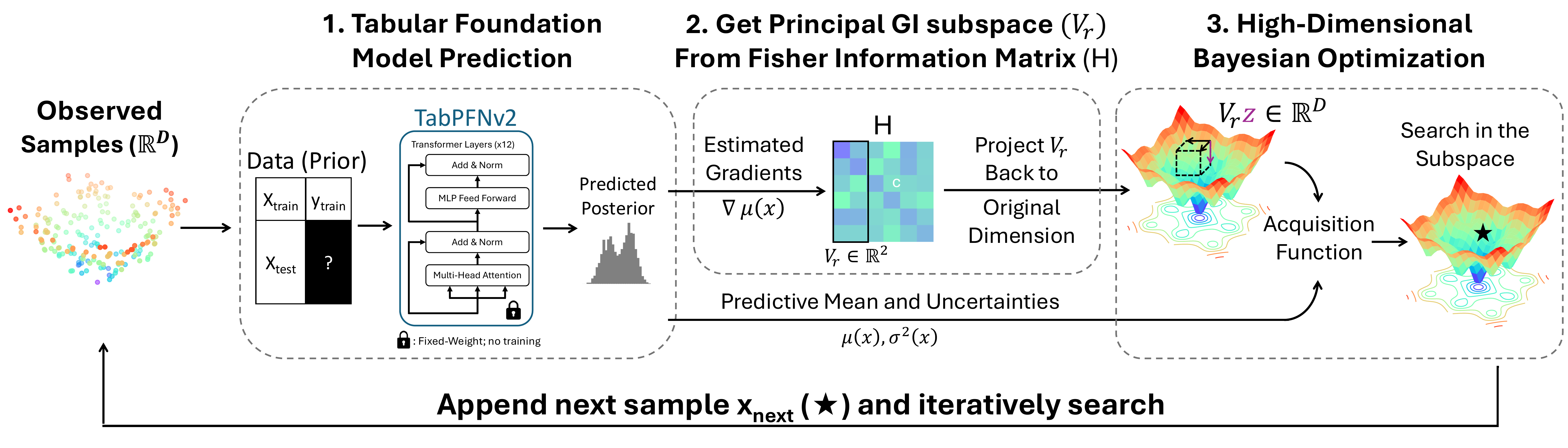
GIT-BO exploits gradients the foundation model already computes in its forward pass. A gradient-informed diagnostic matrix, built from the model's own predictive-mean gradients via a Fisher-information estimate, reveals the most sensitive directions of the search space and continuously re-estimates a low-dimensional active subspace — no fixed embedding, no structural assumptions.
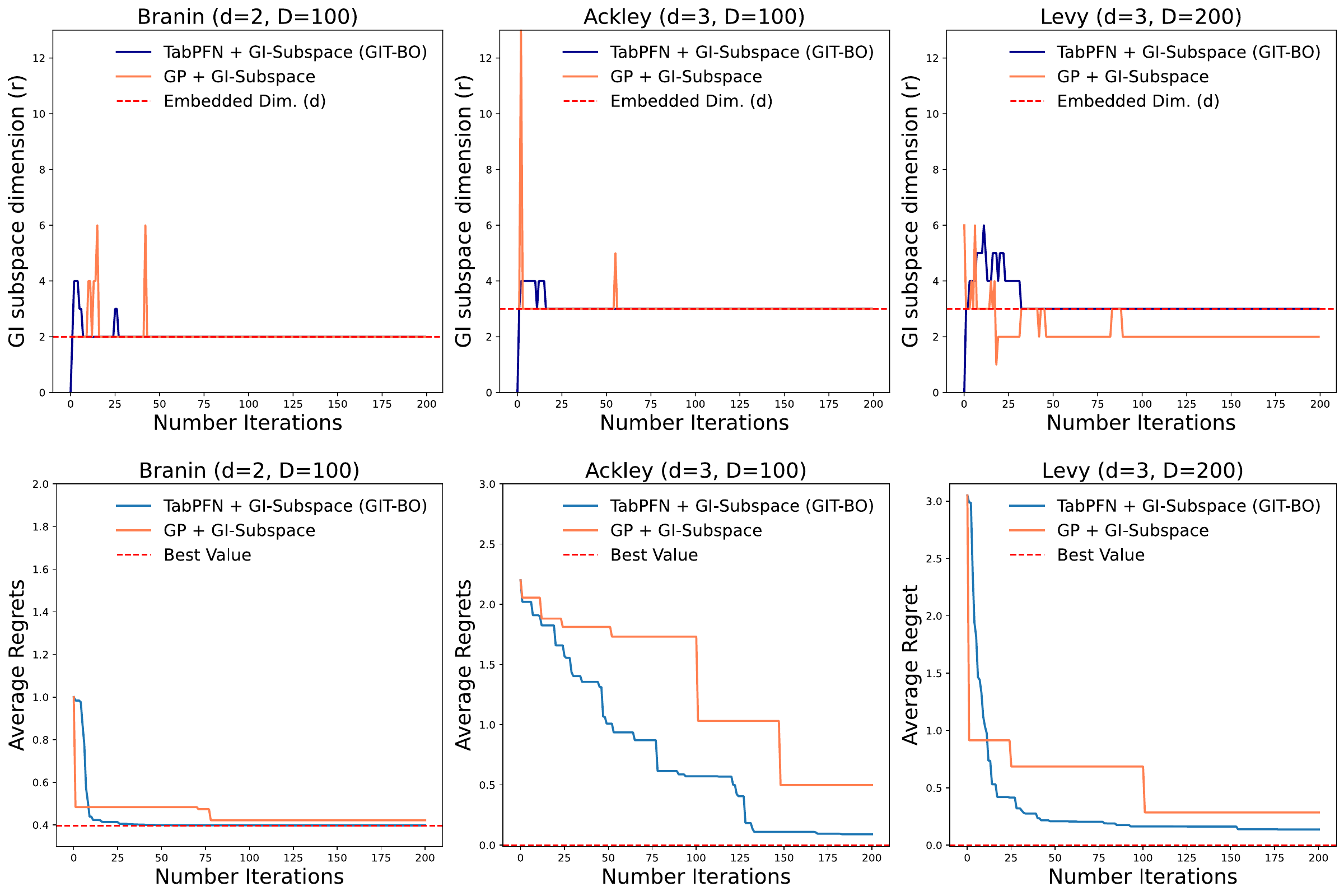
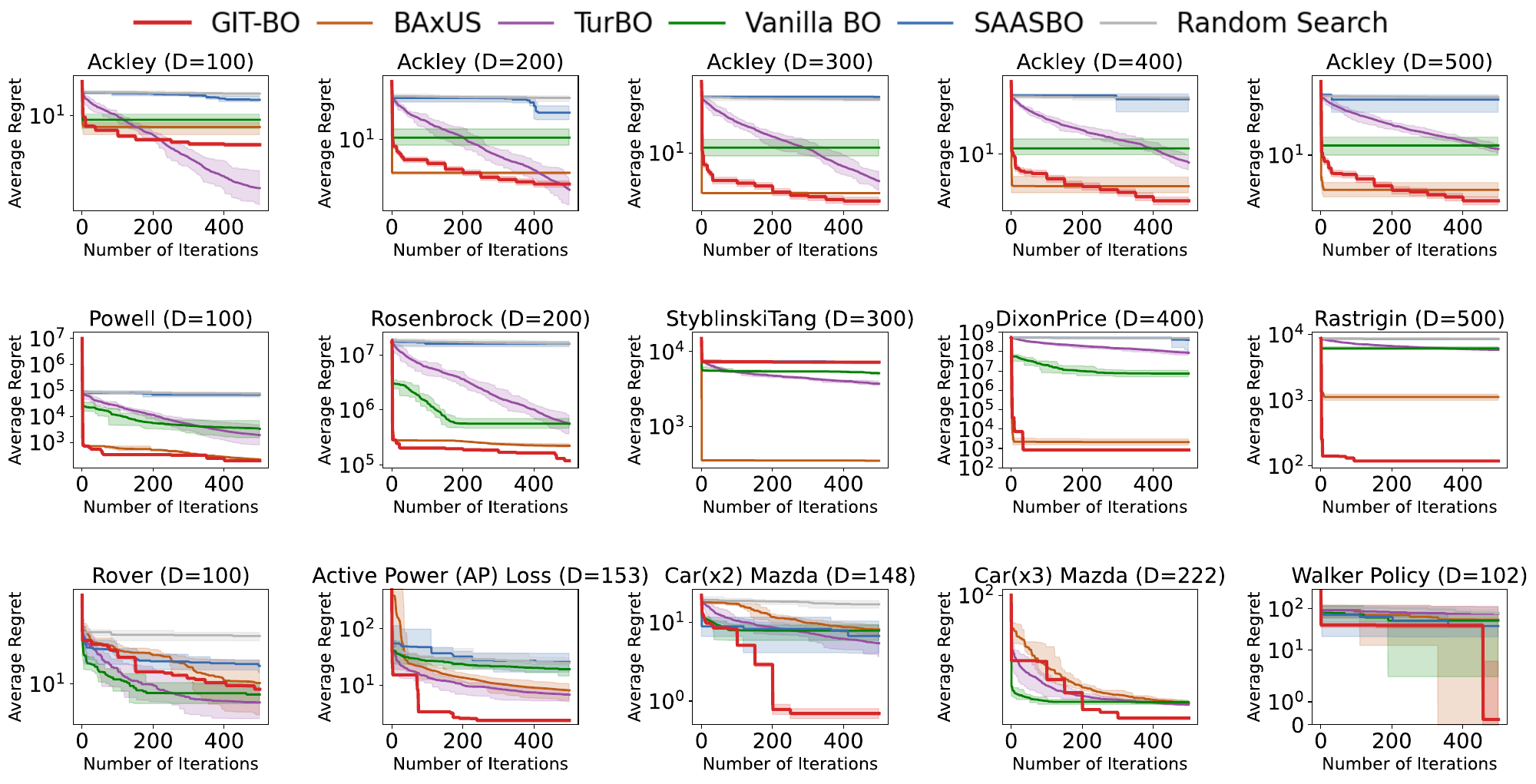
Across 60 problem variants spanning 20 benchmarks — nine scalable synthetic families and eleven real-world engineering tasks including power systems, Rover, MOPTA08, and Mazda vehicle design — GIT-BO consistently outperforms SAASBO, TuRBO, Vanilla BO, and BAxUS, and its advantage grows with dimensionality up to 500D. It ranks first overall on real-world engineering problems.
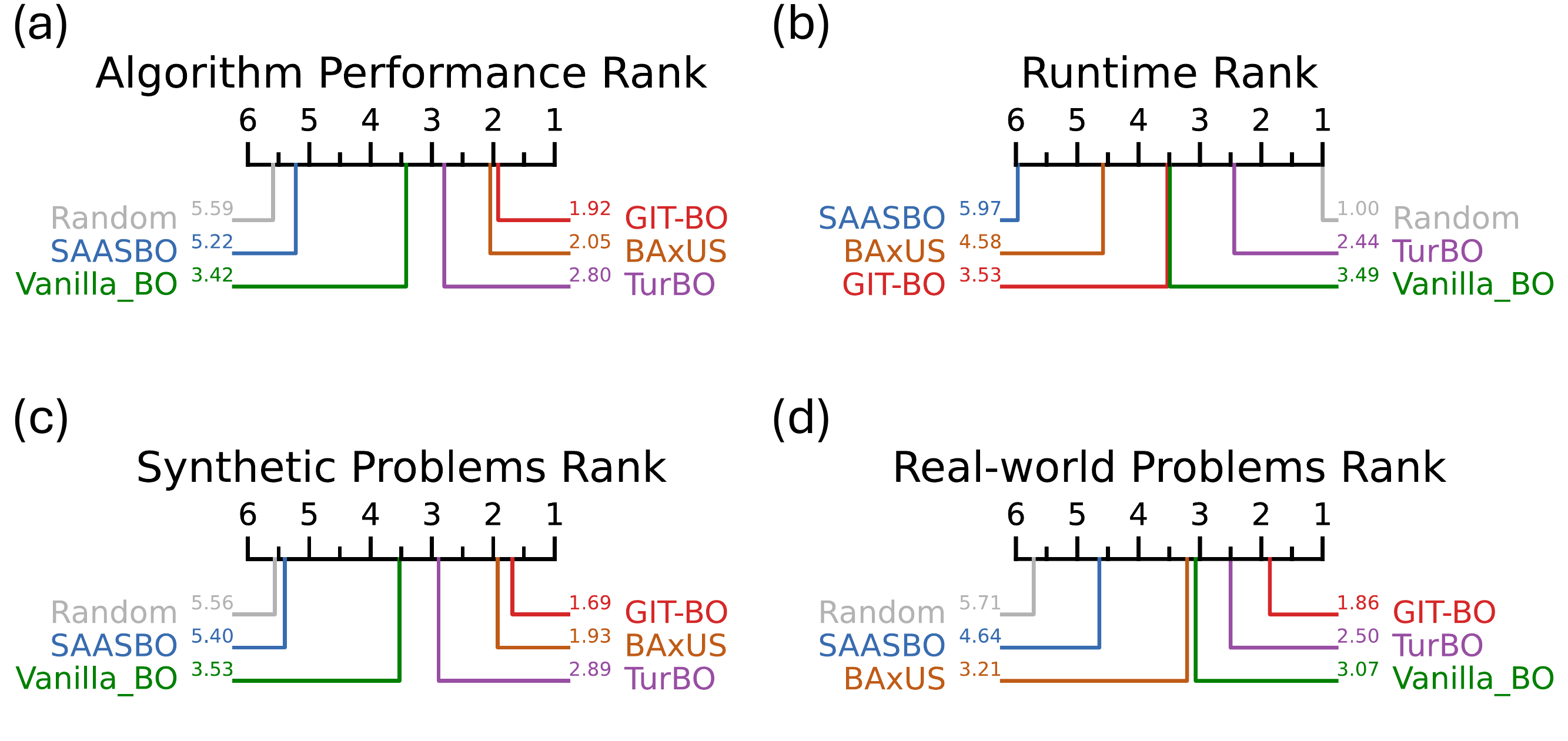
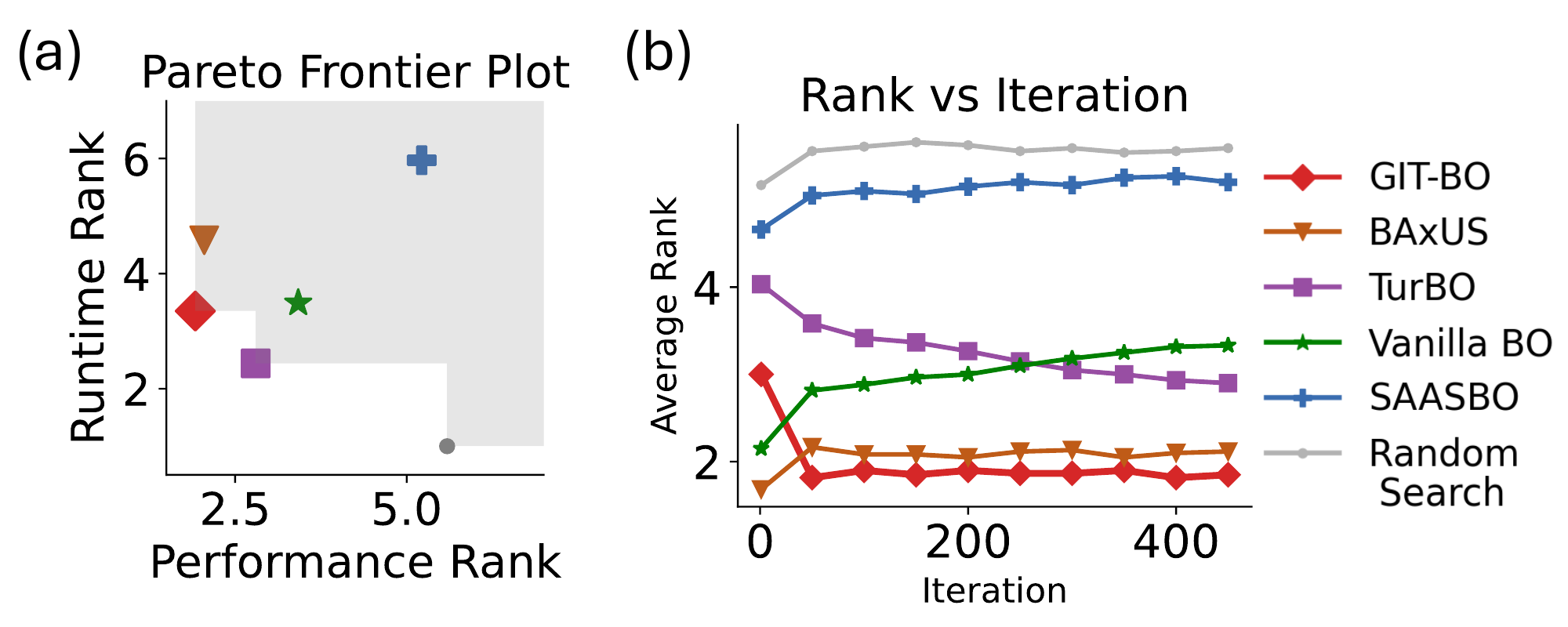
Because the surrogate is never retrained, GIT-BO converges in minutes where GP-based high-dimensional BO methods take hours, delivering a Pareto-dominant performance-versus-time trade-off whose runtime advantage grows with dimensionality.
Yu, Rosen Ting-Ying, Cyril Picard, and Faez Ahmed. 'GIT-BO: High-Dimensional Bayesian Optimization using Tabular Foundation Models.' In International Conference on Learning Representations (ICLR). 2026.
@inproceedings{yu2026gitbo,
title={GIT-BO: High-Dimensional Bayesian Optimization using Tabular Foundation Models},
author={Yu,
Rosen Ting-Ying and Picard,
Cyril and Ahmed,
Faez},
booktitle={International Conference on Learning Representations},
year={2026}}